
“It's yellow, but we can fix it."
I've heard this phrase hundreds of times in status meetings. And every single time, I knew what was coming next.
Red.
Here's the thing about Red-Yellow-Green tracking systems: yellow is a lie. Not intentionally, but functionally. It's the safety net managers use to avoid saying what they already know.
Yellow is just red with extra steps.
Think about it. When does a project go from green to yellow? When something's wrong. And when does it go from yellow to red? When we finally admit the problem isn't going away on its own.
The problem isn't the color. It's what yellow does to our brains.
Yellow gives us permission to delay. It says "I see the problem, but I'm handling it." Except we're not handling it. We're watching it. We're hoping it fixes itself. And every week that passes with a project sitting in yellow is a week we could have been solving the actual problem.
I've watched projects marinate in yellow for months. The manager knew. The team knew. Everyone knew. But yellow gave us all a comfortable place to pretend we didn't.
The fix is simple: remove yellow entirely.
Force the choice. Is this project on track, or does it need help? Green or red. That's it.
When you remove the middle ground, something interesting happens. Problems surface earlier. Managers stop asking "can I fix this without escalating?" and start asking "does this need attention?"
Red stops meaning failure.
That's the real shift. In a binary system, red becomes what it should have always been: a signal that says "we need help here." Not a judgment. Not a mark of shame. Just information.
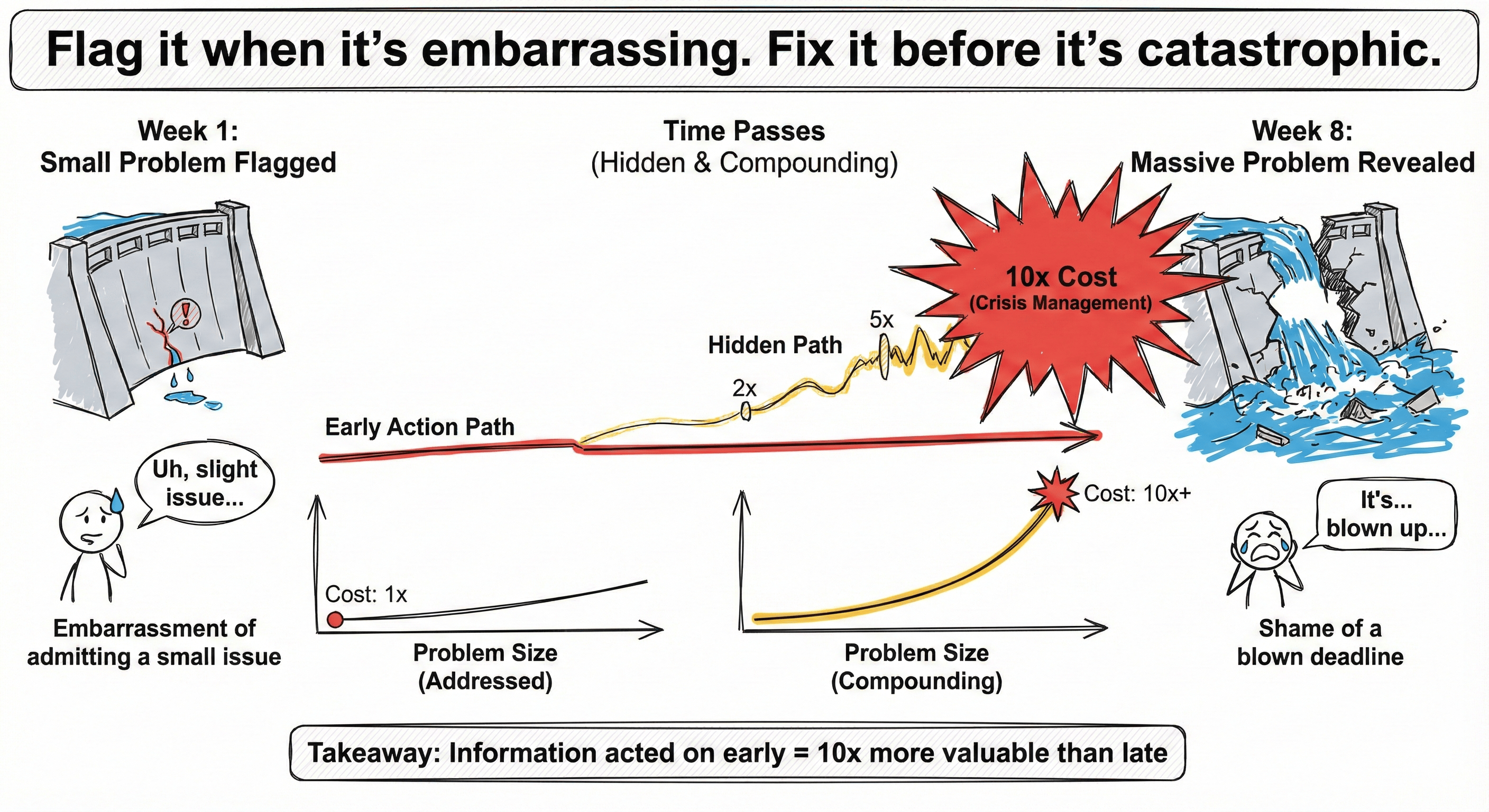
And information you act on early is worth ten times more than information you act on late.
I'm not saying this is easy. Removing yellow feels like removing a safety valve. It forces uncomfortable conversations sooner. It means admitting problems when they're small and embarrassing instead of large and obvious.
But here's what I've learned: the discomfort of early honesty is always cheaper than the cost of late crisis management.
The projects that stay green aren't the ones without problems. They're the ones where problems get flagged before they compound.
So the next time you're tempted to mark something yellow, ask yourself: am I tracking this, or am I hiding it?
If you're hiding it, you already know the answer.
It's red.